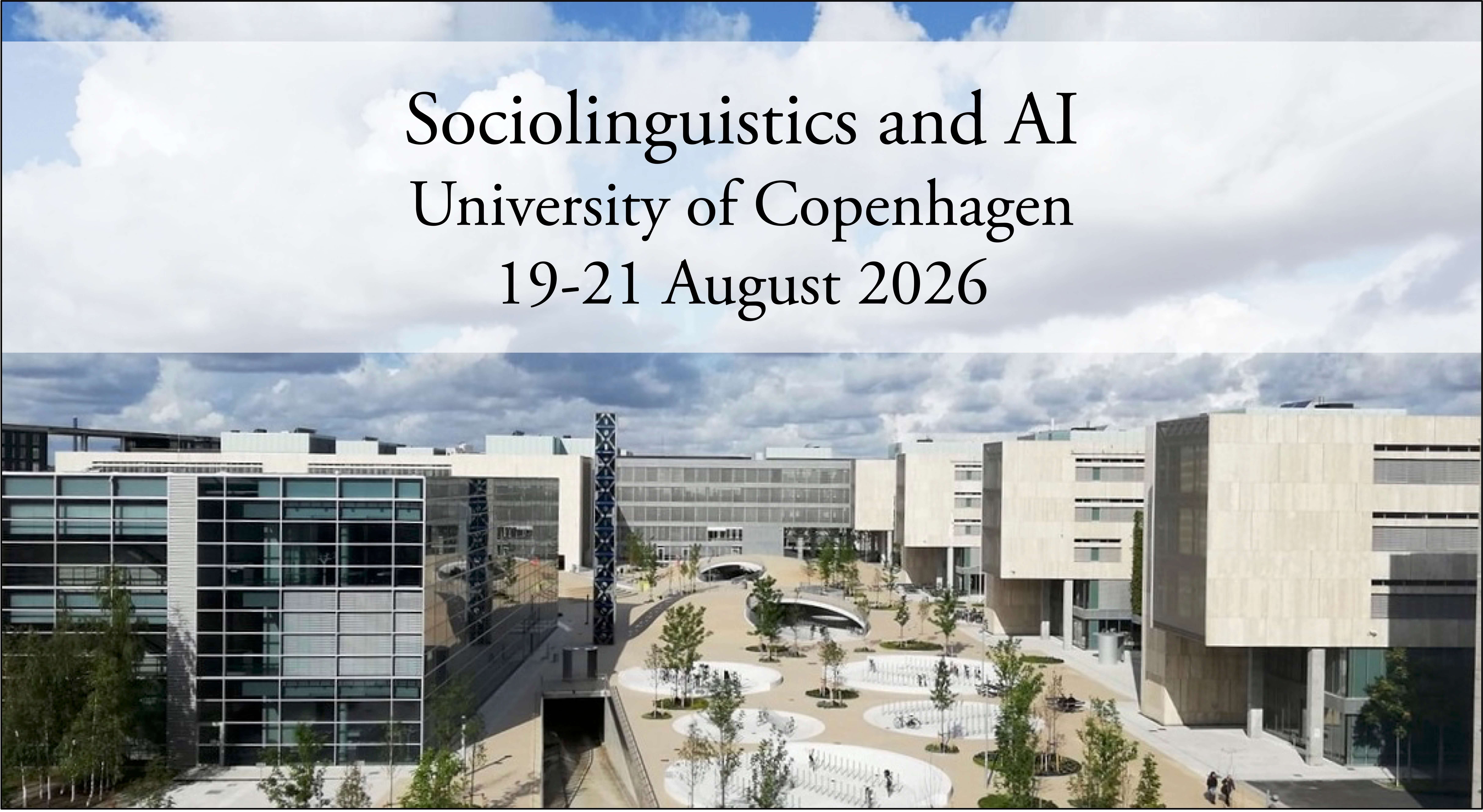
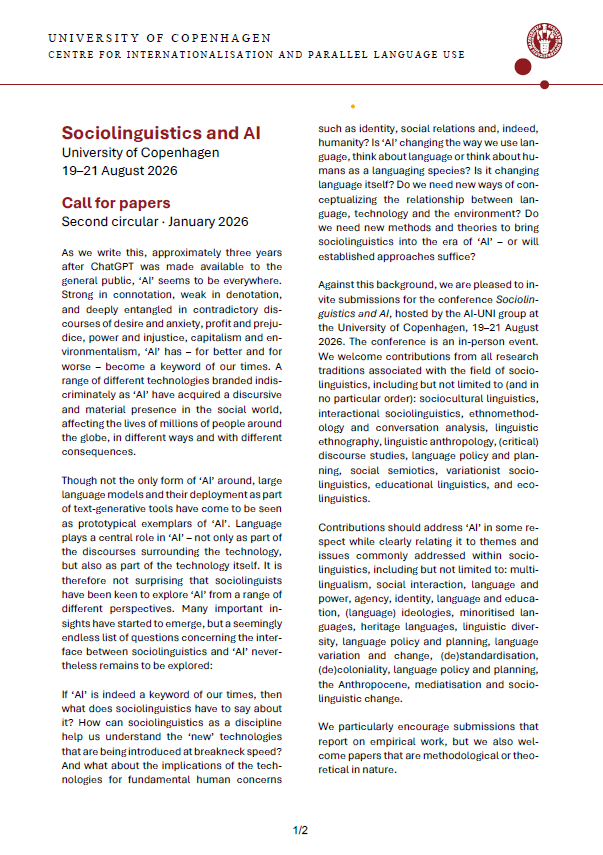
On 19-21 August 2026 the AI-UNI research project and Centre for Internationalisation and Parallel Language Use (CIP) will host the conference Sociolinguistics and AI. The conference will take place at the University of Copenhagen, South Campus. Call for papers is out now. Download the second circular here.
See more information about the conference below.
As we write this, in November 2025, three years after ChatGPT was made available to the general public, ‘AI’ seems to be everywhere. Strong in connotation, weak in denotation, and deeply entangled in contradictory discourses of desire and anxiety, profit and prejudice, power and injustice, capitalism and environmentalism, ‘AI’ has – for better and for worse – become a keyword of our times. A range of different technologies branded indiscriminately as ‘AI’ have acquired a discursive and material presence in the social world, affecting the lives of millions of people around the globe, in different ways and with different consequences.
Though not the only form of ‘AI’ around, large language models and their deployment as part of text-generative tools have come to be seen as prototypical exemplars of ‘AI’. Language plays a central role in ‘AI’ – not only as part of the discourses surrounding the technology, but also as part of the technology itself. It is therefore not surprising that sociolinguists have been keen to explore ‘AI’ from a range of different perspectives. Many important insights have started to emerge, but a seemingly endless list of questions concerning the interface between sociolinguistics and ‘AI’ nevertheless remains to be explored:
If ‘AI’ is indeed a keyword of our times, then what does sociolinguistics have to say about it? How can sociolinguistics as a discipline help us understand the ‘new’ technologies that are being introduced at breakneck speed? And what about the implications of the technologies for fundamental human concerns such as identity, social relations and, indeed, humanity? Is ‘AI’ changing the way we use language, think about language or think about humans as a languaging species? Is it changing language itself? Do we need new ways of conceptualizing the relationship between language, technology and the environment? Do we need new methods and theories to bring sociolinguistics into the era of ‘AI’ – or will established approaches suffice?
Against this background, we are pleased to invite submissions for the conference Sociolinguistics and AI, hosted by the AI-UNI group at the University of Copenhagen, 19–21 August 2026. The conference is an in-person event. We welcome contributions from all research traditions associated with the field of sociolinguistics, including but not limited to (and in no particular order): sociocultural linguistics, interactional sociolinguistics, ethnomethodology and conversation analysis, linguistic ethnography, linguistic anthropology, (critical) discourse studies, language policy and planning, social semiotics, variationist sociolinguistics, educational linguistics, and ecolinguistics.
Contributions should address ‘AI’ in some respect while clearly relating it to themes and issues commonly addressed within sociolinguistics, including but not limited to: multilingualism, social interaction, language and power, agency, identity, language and education, (language) ideologies, minoritised languages, heritage languages, linguistic diversity, language policy and planning, language variation and change, (de)standardisation, (de)coloniality, language policy and planning, the Anthropocene, mediatisation and sociolinguistic change.
We particularly encourage submissions that report on empirical work, but we also welcome papers that are methodological or theoretical in nature.
The conference will begin at noon, Wednesday 19 August, and end no later than 4 pm on Friday 21 August 2026.
A detailed program will be available closer to the conference date.
Nicole Holliday
Nicole Holliday is an Associate Professor of Linguistics at the University of California, Berkeley. Before joining Berkeley in 2024, she was an assistant professor in the Department of Linguistics and Cognitive Science at Pomona College. She received her Ph.D. in linguistics from New York University in 2016, where she wrote a dissertation entitled “Intonational Variation, Linguistic Style and the Black/Biracial Experience”. Her research focuses on sociophonetic variation, prosody, and identity construction and performance. She is especially focused on how both human listeners and machines make social judgments about voices, and how these judgments influence social inequality. Her work has appeared in scholarly venues such as Journal of Sociolinguistics, Laboratory Phonology, and the Journal of the Acoustical Society of America. She has made media appearances in outlets such as the New York Times, the Philadelphia Inquirer, and the Washington Post. She also runs a popular Tiktok account where she posts about linguistics and current events.
Rodney H. Jones
Rodney H. Jones is Professor of Sociolinguistics in the Department of English Language and Applied Linguistics at the University of Reading and a Fellow of the Academy of Social Sciences. His research interests include language and digital media, health communication, language and sexuality, and language and creativity. His recent books include Understanding Digital Literacies: A practical introduction, 2nd edition (Routledge, 2021) Viral Discourse (Cambridge University Press, 2022), and Introducing Language and Society, (Cambridge University Press, 2022). His newest book, Innovations and Challenges in Digital Literacies: Literacies of repair (2026) is available open access from Routledge.
Britta Schneider
Britta Schneider is Professor of Applied Linguistics of Contemporary English at University of Vienna, Austria. Her main research interest are language ideologies, with a focus on the discursive and material construction of languages in transnational, multilingual settings and in digital and machine-learning culture. She hosts the Critical Language and AI Literacy Lab at University of Vienna and received a PhD from Goethe Universität Frankfurt am Main, Germany, and from Macquarie University Sydney, Australia. Publications include Salsa, Language and Transnationalism (2014), “Methodological nationalism in linguistics” (Language Sciences, 2019), “Multilingualism and AI – the regimentation of language in the age of digital capitalism” (Signs and Society, 2022) and “The material making of language as practice of global domination and control: continuations from European colonialism to AI” (with Bettina Migge, AI & Society 2025).
Abstract submission
The deadline for abstract submission was 15 February 2026 at 23.59 (UTC + 01:00). Abstracts must be submitted in English. Notifications of the outcome of submissions will be sent out within a month of the submission deadline.
Read more about the different types of abstracts below.
Paper abstracts
Abstracts for papers must not exceed 1,800 characters with spaces, including references (if any). Titles are counted separately and must not exceed 150 characters with spaces. Presentations will be organised in 30-minutes slots (20-minute presentation; 5-minute Q&A and 5 minutes for change of presenters/ rooms).
Poster abstracts
Abstracts for posters must not exceed 1,800 characters with spaces, including references (if any). Titles are counted separately and must not exceed 150 characters with spaces. Conference delegates at all career stages are encouraged to submit poster abstracts. Posters will be displayed for the duration of the conference and delegates will be invited to interact with the posters throughout. A dedicated session for discussing posters will be part of the conference programme. Presenters are responsible for printing their own posters (Size: A0).
Number of contributions
Contributors may submit a maximum of two abstracts (for papers/posters) and only be the first author and presenter of one of them. In addition to being an author/presenter of papers or posters, delegates may act as panel conveners and/or discussants.
Panel abstracts
Panel proposals must be submitted as packages consisting of an overall panel abstract plus abstracts for each individual paper in the panel. Each abstract in the package, including the overall panel abstract, must not exceed 1,800 characters with spaces, including references (if any). Titles for each abstract are counted separately and must not exceed 150 characters with spaces. Panel conveners chair their own sessions and are encouraged to schedule the contributions in a way that follows the rhythm of regular paper sessions (allowing 5 minutes for changing rooms before the end of each 30-minute interval).
Regular panels will be allocated 90 minutes and must have at least three individual contributions. Individual contributions must not exceed 20 minutes each. Within the allocated timeframe, panel conveners may consider making a short introduction and inviting a discussant. A discussant slot may (but need not) count as one of the three required individual contributions.
Double panels will be allocated 180 minutes and must have at least six individual contributions. Individual contributions must not exceed 20 minutes each. Within the allocated timeframe, panel conveners may consider making a short introduction and inviting a discussant. A discussant slot may (but need not) count as one of the six required individual contributions.
The conference takes place at the University of Copenhagen. It will not be possible to participate remotely.
Registration will open end April 2026.
The conference fee is yet to be determined, but it will not exceed €130. The fee includes all lunches and coffee breaks during the conference programme.
Questions for the organising committee can be sent to ai-uni@hum.ku.dk.
Scientific committee members review abstract proposals and offer advice to the organising committee on matters related to the academic profile of the conference.
| Alfonso Del Percio | FHNW University of Applied Sciences and Arts Northewestern Switzerland, Switzerland |
| Amy Wanyu Ou | University of Gothenburg Department of Languages and Literatures |
| Anne Larsen | University of Copenhagen, Department of Nordic Studies and Linguistics |
| Ashraf Abdelhay | Doha Institute for Graduate Studies, School of Social Science and Humanities |
| Beatrice Zuaro | University of Copenhagen, Centre for Internationalisation and Parallel Language Use |
| Bettina Migge | University College Dublin, School of Languages Cultures and Linguistics |
| Charlotte Sun Jensen | University of Copenhagen, Department of English, Germanic and Romance Studies |
| Daniel Silva | Universidade Federal de Santa Catarina |
| Dave Sayers | University of Jyväskylä, Department of Communication and Language Studies |
| Elisabetta Adami | University of Leeds, School of Languages, Cultures and Societies |
| Francis Hult | University of Maryland, Baltimore County, Department of Education |
| Gavin Lamb | NHH Norwegian School of Economics, Department of Professional and Intercultural Communication |
| Hartmut Haberland | Roskilde University, Department of Communication and Arts |
| Ico Maly | Tilburg University, Department of Culture Studies |
| Janus Spindler Møller | University of Copenhagen, Department of Nordic Studies and Linguistics |
| Joana Plaza Pinto | Federal University of Goiás |
| Joyce Kling | Lund University, Centre for Language and Literature |
| Karin Tusting | Lancaster University, School of Social Sciences |
| Kristin Vold Lexander | University of Inland Norway, Department of Scandinavian Languages and Literature |
| Magda Pischetola | University of Copenhagen, Department of Communication |
| Magdalena Madany-Saa | University of Oslo, Department of Linguistics and Scandinavian Studies |
| Manuel Padilla Cruz | University of Seville, Department of English Philology (English Language) |
| Marella Tiongson | University of Copenhagen, Centre for Internationalisation and Parallel Language Use |
| Marian Flanagan | University of Copenhagen, Department of English, Germanic and Romance Studies |
| Martha Sif Karrebæk | University of Copenhagen, Department of Nordic Studies and Linguistics |
| Miguel Pérez-Milans | UCL, UK |
| Maartje De Meulder | University of Applied Sciences Utrecht |
| Nicolai Pharao | University of Copenhagen, Department of Nordic Studies and Linguistics |
| Nikolas Coupland | Cardiff University |
| Ron Darvin | The University of British Columbia, Department of Language and Literacy Education |
| Sari Pietikäinen | University of Jyväskylä, Department of Language and Communication Studies |
| Shaila Sultana | BRAC University, Bangladesh |
| Sibonile Mpendukana | University of Cape Town, Department of African Studies and Linguistics |
| Slobadanka Dimova | University of Copenhagen, Centre for Internationalisation and Parallel Language Use, |
| Spencer Hazel | Newcastle University, School of Education, Communication and Language Sciences |
| Sune Sønderberg Mortensen | Roskilde University, Department of Communication and Arts |
| Tanya Karoli Christensen | University of Copenhagen, Department of Nordic Studies and Linguistics |
| Virginia Zavala Cisneros | Pontifical Catholic University of Peru, Academic Department of Humanities |
| Viviane de Melo Resende | University of Brasília, Brazil |
The conference is organised by the AI-UNI research group, based at the Centre for Internationalisation and Parallel Language Use (CIP), at the University of Copenhagen: Sam Goodchild, Kasper Engholm Jelby, Jens Christian Borup Green Jensen, Sanne Larsen, Rafael Lomeu Gomes, Sofie E. A. Søndergaard and Janus Mortensen.
Questions for the organising committee can be sent to ai-uni@hum.ku.dk.
Keynote presentations
Evaluative Speech AI and the Devaluation of Sociolinguistic Competence
Nicole Holliday
Linguists take it as axiomatic that speakers are experts on their languages, both in grammar and usage. However, as Large Language Models (LLM) trained on text and speech become ubiquitous in domains from daily tasks to education and employment, human expertise about language is increasingly devalued. This talk will present the results of three studies that focus on LLMs that are designed to evaluate and “improve” the speech of human talkers; these systems are known as Socially Prescriptive Speech Technologies (SPSTs). The first study shows how the Amazon Halo, a wearable device that claims to evaluate “tone of voice” does not function as advertised, and in fact systematically negatively evaluates the speech of Black talkers and women. The second study focuses on systems such as Read. AI and the Zoom Revenue Accelerator, which claim to evaluate communicative effectiveness in videoconferencing contexts. Results of a laboratory experiment comparing these products’ evaluations of speakers show evidence of systematic bias against black speakers and individuals who identify as neurodivergent, while also reinforcing “standard” language ideologies and failing to provide consistent, actionable feedback to users. Finally, the third study analyzes the outputs of “accent translation” programs marketed by companies such as Sanas and Krisp, showing that such programs do not functionally “translate”3 accents but rather transform speech to an imagined “American” style that is poorly evaluated by human listeners. Taken together, these studies show that “AI”-based programs that purport to evaluate human speech do so without consideration of linguistic principles or acknowledgement of speakers’ sociolinguistic competencies. Such systems also act without transparency for both designers and users by design, reproducing social stereotypes inherent to their training data. As a result, they advise humans to produce unnatural speech, and they punish speakers who do not conform to the narrow targets established by an LLM’s training data. As such technologies are already being used to make employment decisions, provide speech therapy, and even draft police reports, the fact that these systems systematically misevaluate speech represents a significant threat to all people, but most especially those from marginalized groups.
Animating AI
Rodney Jones
In this talk I will explore the ways humans ‘animate’ AI – or ‘call it into being’ – through language, drawing on work in linguistic anthropology on animism, animation and the performative nature of speech genres (Bird-David, 1999; Bauman, 2004; Silvio, 2010). While ‘calling AI into being’ is a complex, distributed process involving multiple social actors and multiple genres (from the databases on which models are trained to the demos that AI companies stage to market their products), in this talk I focus on the prompt as a foundational genre through which users participate in animating AI chatbots, transforming them into legitimate participants in recognisable social practices. The prompt, I will argue, is a hybrid genre that functions simultaneously as a set of machine instructions and as a performative utterance deeply affected by human social imaginaries. As such, it inherits two seemingly incompatible lineages: the procedural pragmatics of programming and the more ‘mystical’ pragmatics of spells, invocations, and magic tricks.
Through an analysis of a corpus of ‘metapragmatic artefacts’ on prompting (consisting of things like industry manuals, commercial course materials, media stories, TikTok videos and conversations on Reddit), I examine how these two lineages collide in contemporary prompting repertoires across three sites: the professional discourse of ‘prompt engineering’; the collaborative experimentation of everyday users; and the more ‘magical’ prompting practices promoted by influencers and entrepreneurs who offer ‘secret’ prompts which they promise followers will help them to ‘wake up their AI’. These three repertoires index radically different ideologies of language and communication, with industry manuals and ‘prompt engineering’ courses constructing prompting as a high-stakes form of linguistic optimisation, ordinary users treating it as an experiential social practice, and ‘prompt gurus’ depicting it as performative and transformational. They also index different socio-technical imaginaries regarding human relationships to technology. As users engage in these different (often intersecting and overlapping repertories), they don’t just animate AI, but are also animated by it, transformed into different ‘kinds of humans’, such as ‘elite language workers’, ‘tech-savvy tinkerers’, ‘adversarial hackers’, and ‘AI whisperers’ able to coax models into consciousness. What unites all of these approaches, though, is an understanding that prompting is not simply a matter of formulating instructions or commands but an inherently anticipatory and improvisational activity deeply embedded in what Bird-David (1999) calls the ‘relational epistemologies’ of animism. It is a form of ‘languaging’ through which users learn what AI can do and what AI can be by trying to make it do things and ‘be’ things. Prompts are probes, wagers, world-building moves, which call forth identities, scenarios and imaginaries both for technologies and for the humans that use them.
References
Bauman, Richard. 2004. A world of others’ words: Cross‐cultural perspectives on intertextuality. Wiley. https://doi.org/10.1002/9780470773895
Bird-David, Nurit. 1999. ‘Animism’ revisited: Personhood, environment, and relational epistemology, Current Anthropology 40(S1). S67–S91. https://doi.org/10.1086/200061
Silvio, Teri. 2010. Animation: The new performance? Journal of Linguistic Anthropology 20(2). 422–438. https://doi.org/10.1111/j.1548-1395.2010.01078.x
The Ungrounded Sign. Meaning-Making, Community and Democracy Under Machine Influence
Britta Schneider
In this talk, I ask what happens to linguistic signs in societies that make use of algorithmic language technologies and what this may imply for community formation and democratic culture. The discussion is based on theoretical considerations concerning sign making and semiotic ideology from linguistic anthropology (Gal & Irvine 2019, Keane 2018, Silverstein 2014), where shared meanings of linguistic signs and human communities are understood as dialectically producing each other. In this sense, the development and sharing of linguistic signs is a collective process that produces human sociality. The linguistic signs generated by LLMs are not based on procedures of human interactive meaning-making and seem to be generated simultaneously within and across communities and integrate machine-learning logics into human interaction. LLMs thus manufacture signs but have no community grounding. Which kinds of signs and communities come into being where commercial algorithmic and big data logics interfere with the ability of humans to create signs, meanings and community? What happens if non-accountable signs circulate in so far unidentified forms across communities? Who has the power to define the meaning of signs in such techno-linguistic formations? And how can meaning, trust and truth – and thus democratic discourse culture – be ensured where signs are co-produced by algorithmic machines?
In order to shed light on these questions, I discuss examples of public debates and current policies concerned with governing language technology. Traditional national language-norming institutions often react to new language actors by claiming that signs created by machines are ‘inauthentic’ and thus reinvoke traditional epistemologies of humans as autonomous, rational beings and communities and linguistic signs as stable and territorially ordered. Big Tech leaders exploit collective, community-based human semiotic resources at global scales and produce discourses that construct an image of language technologies as isolated from society, freeing them from social responsibility. At the same time, populist politicians dream of determining the meanings generated by machines and simultaneously engage in individualistic strategic appropriations of linguistic signs that remind of Orwell’s Newspeak. They thus contribute to the era of post-truth and promote totalitarian meaning-regimes that are envisioned for the entire planet.
Drawing on these observations of public contestations over meaning, power and responsibility, I develop thoughts on which literacies are needed to support democratic institutions and community-based agency in societies shaped by unaccounted-for machine-created signs.
References
Gal, Susan & Judith T. Irvine. 2019. Signs of difference: Language and ideology in social life. Cambridge University Press.
Keane, Webb. 2018. On semiotic ideology. Signs and Society 6(1). 64–87. https://doi.org/10.1086/695387
Silverstein, Michael. 2014. Denotation and the pragmatics of language. In N. J. Enfield, Paul Kockelman & Jack Sidnell(eds.), The Cambridge handbook of linguistic anthropology, 128–157. Cambridge University Press.
Details
Time: 19 Aug. - 21. Aug. 2026
Place: University of Copenhagen, South Campus, Denmark
Organiser: The AI-UNI research project and the Centre for Internationalisation and Parallel Language Use
Call for papers
The AI-UNI project is funded by the Carlsberg Foundation.